Goldmund Finds a Family’s Bodies in a Plague-Stricken Farmhouse
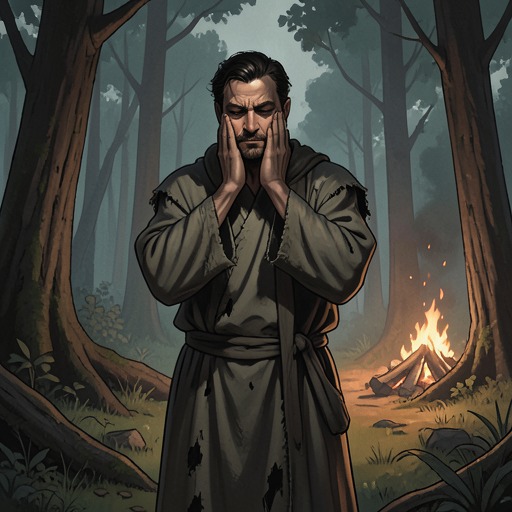
Narcissus and GoldmundGoldmund Finds a Family’s Bodies in a Plague-Stricken Farmhouse is a defining encounter with the Black Death: an apparently deserted rural home reveals the deaths of an entire household, while Goldmund’s response sets his searching attention against Robert’s immediate fear. The scene makes the plague tangible through ordinary signs of interrupted life and shows how Goldmund converts exposure to death into both compassionate attention and an artist’s study of human fate.
The Road to the Farmhouse
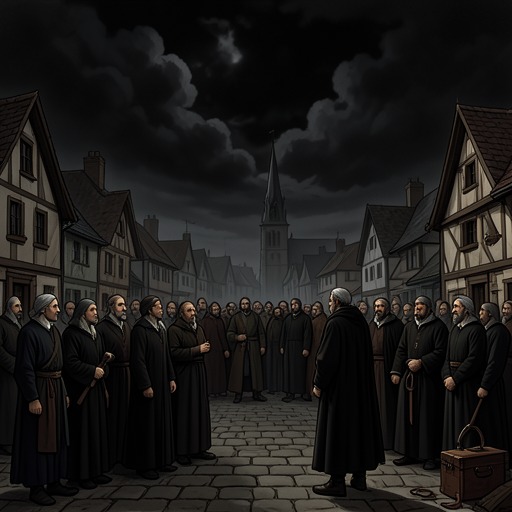
Goldmund and Robert first meet resistance near a village. Peasants armed with cudgels, poles, and flails order them to turn back, and a stone thrown at Goldmund makes clear that the warning is not an empty threat. Robert runs; Goldmund follows him beneath a crucifix in a field. Neither understands why the villagers have barred their way. The next morning, their arrival at an isolated farm begins to answer that question.
The farm comprises a hut, stable, and barn among crops, high grass, and fruit trees. Its stillness is at odds with the signs of daily work: no people answer, while a cow stands in the courtyard lowing as if waiting to be milked. The stable is open and empty, and the barn yields no one. Their search turns an unexplained absence into an increasingly troubling discovery; the neglected cow is not merely a detail of the landscape but evidence that the household’s ordinary care has stopped.
The Discovery
After repeated knocks bring no answer, Goldmund finds the hut unlocked and goes inside. Robert stays outside. In the darkened room, Goldmund calls out, then notices the remains of a fire and a person seated beside the hearth. The woman does not respond when he touches her shoulder. He rekindles the fire, uses a piece of kindling for light, and sees that she is dead. The scene’s first revelation comes by degrees: silence, an unanswered call, and a motionless figure resolve into the certainty that someone has died alone at home.
Goldmund continues through the house with the burning stick. At the threshold of a back room lies a boy, perhaps eight or nine, his body across the sill. Beyond him are three beds: one empty, one holding a dead bearded man, probably the farmer, and another containing a woman and a half-grown girl. Together with the old woman by the hearth and the boy at the doorway, they make five dead members of one household. The abandoned beds, the overthrown water jug, and the room’s ordinary domestic arrangement register a family’s final hours without explaining precisely when or how each person died.
Goldmund looks closely at the different postures. He reads the boy’s position across the threshold and clenched hands as signs of suffering and futile struggle; the man’s rigid bearing suggests endurance, while the mother’s posture and disordered hair convey fear and a wish to escape. These are Goldmund’s interpretations of what he sees, not a recovered account of the family’s last moments. The distinction matters: the house offers no testimony, only bodies and details from which he tries to understand what death has done.
The discovery affects Goldmund through two modes at once. He is moved by pity, yet he also observes the bodies with the concentrated detachment of an artist, attending to how the figures have come to rest. Rather than leave as soon as he understands the scene, he gives himself over to looking. The unlocked home places death not in a hidden grave but in the rooms where the family lived, turning what would usually remain unseen into an encounter he cannot dismiss.
Robert Recognizes the Plague
Robert calls from outside, frightened by Goldmund’s silence and the time he has spent in the house. When Goldmund finally tells him that five people are dead, Robert understands why the villagers had tried to keep strangers away: he concludes that the plague has killed the family. He fears that Goldmund may have been exposed and tries to leave rather than remain with him.
Goldmund stops him. He acknowledges that Robert may be right about the plague, but insists that they face the danger together. He promises to bury Robert if he dies and says that neither should abandon the other to die alone. The immediate consequence is practical as well as emotional: he orders Robert to fetch a bucket so they can milk the cow. From that point, Robert obeys Goldmund’s direction, and they continue together rather than separating in panic.
The two men’s different responses establish a contrast that persists as they travel. Robert fears infection, watches his body for signs of illness, and tries to protect himself with smoke from their campfire. Goldmund does not share his disgust or fear. The farmhouse has shown him an unavoidable human fate, not merely a danger that belongs to the dead family; he tells Robert that what they saw awaits everyone, whether or not either catches the plague.
Meaning and Aftermath
The encounter opens into a wider journey through a country marked by the Black Death. They find deserted farms, unburied dead, and livestock left without care. Some communities refuse entry to strangers, while others allow them to pass. Goldmund and Robert milk and feed animals and find food and drink in abandoned places, but material abundance does not make their circumstances secure or uncomplicated. Robert remains anxious; Goldmund moves through the devastation with fascination and sorrow.
For Goldmund, the farmhouse becomes part of a sustained reckoning with mortality. Later, he sees death carts carry bodies to a vast pit outside a fortified town and watches the dead being deposited there. In a cloister, a painted Dance of Death presents death as an unavoidable end for people of every station. Goldmund respects the painting, but his own sense of death differs: he understands it not only as stern judgment, but also through an image of the mother and the call of home. The farmhouse’s intimate domestic scene thus anticipates the wider conflict between public images of death and his deeply personal, imaginative response to it.
The discovery also clarifies what distinguishes Goldmund’s attention from Robert’s. Robert sees a reason to flee; Goldmund stays with the evidence, studies it, and insists on shared responsibility for what may follow. His attention is not simply detached observation: compassion shapes his refusal to leave Robert, while the memory of the household’s stillness feeds his reflections on the universality of death. The scene joins artistic perception to an ethical question—how to look at suffering without turning away, and how to remain beside another person in danger.